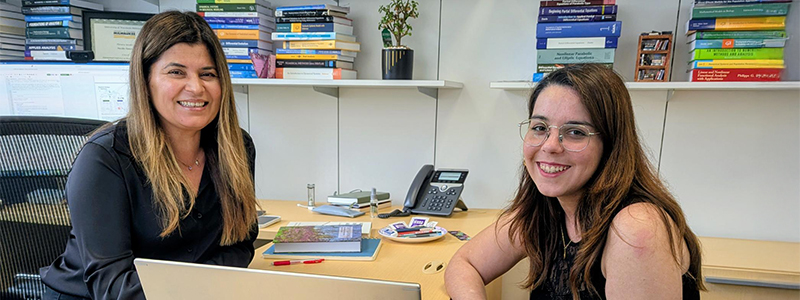
 I am 28 years old and I come from Naples, Italy. This is my first experience living abroad and also the first time I have lived alone, so moving to the United States has been both exciting and challenging in many different ways. I earned my Bachelor’s degree in Mathematics in 2020 from the University of Naples Federico II, and in 2023 I completed my Master’s degree in Applied Mathematics at the same university, with a thesis in fluid dynamics. During the same year, I was admitted to a national PhD program that eventually brought me here to Florida Atlantic University.
My PhD program requires a six-month research period abroad at an international university or research center. The doctoral program is coordinated by the University of Pavia and involves fourteen Italian universities and research institutions across the country. As part of the program, each PhD student carries out their research activities at one of the participating institutions. In my case, I conduct my research at the University of Naples Federico II, the same university where I completed both of my degrees.
The title of the PhD program is One Health Approaches to Infectious Diseases and Life Science Research. It is a highly multidisciplinary program centered around the concept of One Health, which focuses on the connections between human health, animal health, ecosystems, and the environment. In my cohort, which is also the first class of students in the history of this PhD program, I am the only mathematician. Most of the other students come from medical or biological sciences backgrounds.
Within this multidisciplinary environment, mathematics plays an important role in developing models capable of describing complex epidemiological dynamics and supporting public health decision-making. My research focuses on epidemiology and, in particular, respiratory viruses.
During my first year as a PhD student, a doctoral student from Shanghai University spent a research period at the Department of Mathematics of the University of Naples Federico II, where I work. Through our collaboration, I was introduced to the fundamentals of identifiability analysis, a topic that later became one of my main research interests. Together, we published a paper applying identifiability analysis to an epidemiological model describing COVID-19 and influenza coinfection in Italy during the 2023–2024 season.
I also had the opportunity to present this work several times through talks and posters at both national and international conferences, which has been one of the most rewarding experiences of my PhD journey so far. At the moment, this is my first published paper, but I already have other ongoing projects. One study, currently available on arXiv and under review, analyzes pertussis transmission in Italy through a discrete stage-structured epidemiological model divided into two age classes. In addition, my research group in Naples has recently submitted another work focused on RSV transmission using a continuous stage-structured ODE model.
At the same time, together with another collaborator from Shanghai University, I am working on a follow-up study on COVID-19 and influenza coinfection in Italy during the 2024–2025 season. Through this project, I returned once again to the topic of identifiability analysis.
In many ways, identifiability analysis is also the reason why I am here at Florida Atlantic University today. I am extremely grateful to Professor Necibe Tuncer for welcoming me to FAU and giving me the opportunity to deepen my knowledge of identifiability analysis and numerical analysis while broadening my academic perspective.
I arrived here two months ago and I will return to Naples in September, only a few weeks before completing my PhD. During my time at FAU, I will also be working on my doctoral thesis, which focuses on identifiability analysis, respiratory virus coinfections, and scenario-based analyses of diseases such as pertussis and RSV.
To be completely honest, I am a very ambitious person, but I have never had a perfectly defined long-term goal. At every turning point in my life, I evaluate the opportunities available to me in that moment and choose the path that feels right. Until a few months before graduating with my Master’s degree, I had never seriously considered pursuing a PhD. Now I am here, incredibly grateful that I decided to take this path. So far, trusting myself this way has worked well.
I would like to continue working in research because it has already given me many rewarding experiences, both professionally and personally. At the same time, one of the biggest challenges of an academic career is the possibility of having to live far away from home for long periods of time. I have a very strong connection with my hometown, Naples, and I am not sure whether these two aspects of my life will always be compatible. For this reason, I prefer to remain open to future opportunities and decide step by step.
What I know for certain is that I am grateful for the opportunity to spend six months here. If my PhD program had not required an international research experience, I might never have left home. In a way, I left because I had to, but also because I knew I would eventually return. That made it easier to take such a big step.
Living on the other side of the world, surrounded by a completely different culture and environment, has already become one of the most meaningful experiences of my life. It is giving me not only professional growth, but also personal growth that will stay with me no matter what I decide to do in the future.
Outside of academia, I am a very simple and family-oriented person. I was born and raised in Naples, and my family has always supported me while also giving me the freedom to make my own choices. I have a younger brother who is eight years younger than me, and despite the six-hour time difference, my family and I manage to stay in touch every day. Being far away from them, especially from my mother, is not always easy, but during these first months we have found our own balance despite the distance.
I am generally a quiet person. I do not particularly enjoy parties or nightlife, but I know how to have fun in my own way. I love music and sports, especially soccer and Formula 1. I support Napoli, the soccer team from my hometown, and it is definitely one of the great passions of my life.
One of the most unforgettable experiences I have had since arriving in the United States was attending my first Formula 1 race in person. I also love concerts and traveling. Before this experience abroad, I had mostly traveled around Italy, with only two previous international trips: one to London for a concert and another to Ethiopia for a scientific conference. Now, after moving alone to the other side of the world, I feel much more confident about discovering new places and cultures in the future.
I am also quite sociable, even if at first I may seem shy. I love humor and sarcasm, and I usually always have a quick answer ready. Hopefully, by the end of my time here, my English will improve enough for me to be just as funny in English as I am in Italian. Maybe saying that sounds a little too confident, but I promise I do not take myself too seriously.
